
Why I’m Not Celebrating About the Size of the Democratic Advantage in Today’s NYT/Siena Survey
The release of today’s The New York Times/Siena University survey is undoubtedly chock full of great news for Democratic hopes to win back one or both chambers of Congress this November (Dan Pfeiffer has a solid write-up of how terrible the news is for Republicans in The Message Box). In addition to Democrats holding an 8-point lead among likely voters in the congressional generic ballot, a few contextual data points worth noting:
The national atmospherics are dreadful for Republicans: Those saying we’re headed off on the wrong track is 27 points worse than those saying the country is headed in the right direction.
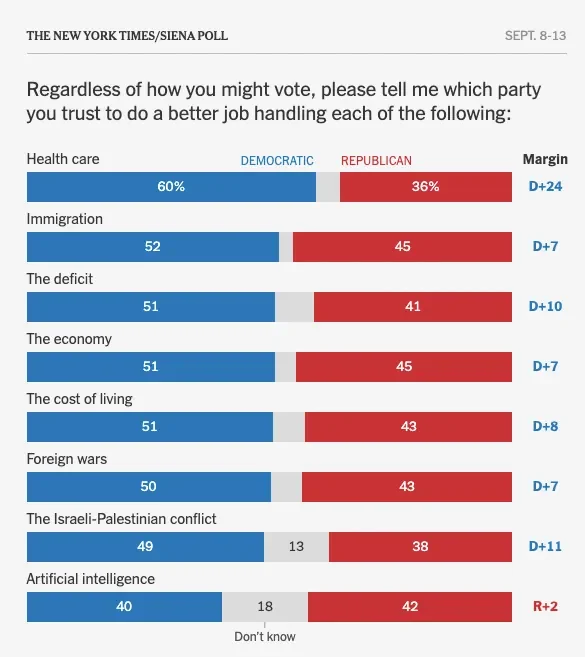
The Democratic Party has key issue advantages1: Notably, Democrats hold a 24-point advantage on health care, but their margins on the economy (D+7) and the cost of living (D+6) mirror the generic ballot result when Republicans have historically held an advantage on the economy.
Voters agree more with the Democratic Party on both cultural issues and economic issues: Though more of a mixed bag, net agreement with Democrats on cultural issues is +2 and on economic issues is -3; by comparison, net agreement with Republicans is -9 and cultural issues is -12.
While this is all great news for Democratic prospects in the midterms, I’m not celebrating because quite simply, they should be performing better.
Walking Through the Data is a reader-supported publication. To receive new posts and support my work, consider becoming a free or paid subscriber.
I wrote about this over the summer, but the reality is that the national environment is far more toxic for Republicans today than it was just prior to the 2018 midterm elections where Democrats took back the House, yet vote preference remains the same. I went back into the archives and found a Suffolk University/USA Today survey from October 2018 that had the exact same result as today’s NYT/Siena survey—51 percent preferring Democrats to 43 percent preferring Republicans—and made some comparisons, especially since that was quite close to the actual result in 2018.2
Assessments of national performance are worse today than they were in 2018: Net right track-wrong direction was -19 in 2018 (and was only -12 in the 2018 exit poll) compared to -27 in today’s survey. Donald Trump’s overall approval rating was -11 in 2018 (and -9 in the 2018 exit poll) compared to -21 in the NYT/Siena poll. And while the Suffolk/USA Today poll did not ask Trump economic approval, Trump was overperforming on this metric compared to his overall presidential handling in his first term; today, it’s in line with that and deeply negative (net -21).
There is little evidence of divergence from 2018 voting trends by demographic groups: Admittedly, it’s a little fraught to put too much stock in demographic changes from one 1,000 likely voter survey from one source in 2018 to another 1,500 likely voter survey from a different source in 2016, but I was shocked by the consistency. Looking at gender, race, region, and education, there were two potentially interesting differences; otherwise, the results were remarkably similar.
The gender gap: In 2018, Suffolk/USA Today found men favoring Democrats by 4 points (2018 exit poll favored Republicans by 9) and women preferring Democrats by 13 (the exit poll favored Democrats by 19). The gender gap in the NYT/Siena survey was very close to the 2018 exit poll (men favoring Republicans by 5 points and women favoring Democrats by 19 points).
Hispanic/Latino voters: There was little difference by any racial subroup between 2018 and 2026 except among Hispanic voters, where Suffolk/USA Today had Democrats winning by 21 points and today’s NYT/Siena survey had them winning by 43 points. I would put an extra note of caution around this finding because of the sample size of Hispanic/Latino voters in each survey and the difficulty of collecting a representative sample of them generally (though this would align with other recent polling also finding erosion of Hispanic/Latino support in Trump and Republicans). And, Democrats won by 40 points among Hispanic/Latino voters in the 2018 exit poll, so that kind of snapback from 2024 would not necessarily translate into a better performance in 2026 overall than in 2018.

This post is not meant to rain on the parade of those who want to see a Democratic takeover of the House in Senate in a few weeks. In fact, it is quite the opposite. But we also should not obscure very real problems facing the Democratic Party that see no sign of clear reversal in the immediate future. To me, that starts with grappling with the fact that there is currently zero additional political or electoral penalty for Trump and Republicans despite a more negative political environment for them.
It should also mean that we start focusing more on how to undo the consistent trend of independents and self-identified Democratic partisans expressing dissatisfaction with their own party. Last week’s Quinnipiac University survey found fewer than half of Democrats approving of the job of their own party in Congress and only 18 percent of independents approving; Republicans fare better only because they have slightly higher satisfaction among their own partisans.
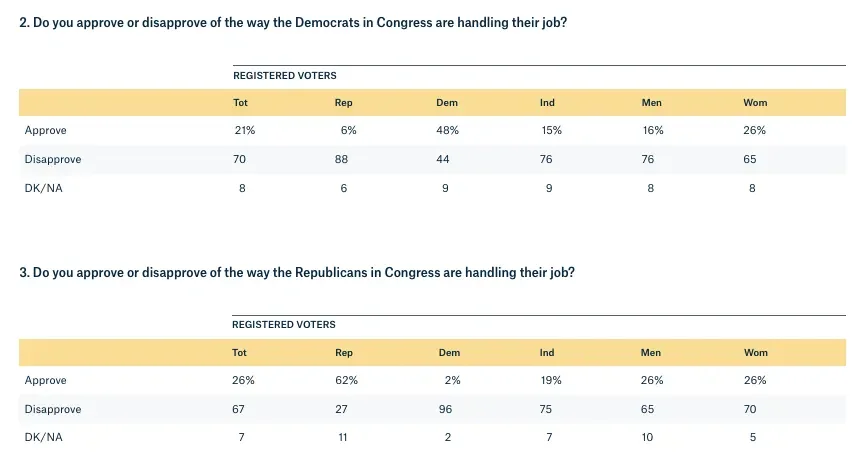
Democrats are not on the path to victory because voters like them, but because of anti-incumbent sentiment is prevailing. If voters did like them more, the lead would be more than 8 points.
And focusing too much on short-term electoral success only risks overlooking their brand problem that could put their electoral prospects in significant peril in future elections when they are incumbents on the ballot.
1 While not the focus of this post, it’s worth noting somewhere the 7-point Democratic advantage on immigration, another issue that historically favors Republicans.
2 Ideally I would have used a national NYT/Siena survey from 2018, but if you might recall, this was when they did the congressional district live polling experiment, so there was not one available to do a direct comparison to.
