
Democrats May Win the Midterms, But They're Underperforming Compared to 2018
As of today, Democrats are on track to win back the House of Representatives: FiftyPlusOne’s generic ballot average has Democrats ahead by 5.9 points, and Silver Bulletin’s average has Democrats ahead by a similar 6.4 points. Democrats winning by this margin would likely easily overcome the structural advantage Republicans have created from mid-decade redistricting across the country. Compared to this point in time in 2018—the first time Democrats were trying to win back control of Congress in the midterm election of a Trump presidency—these margins are similar to the leads Democrats held that summer, and not far off from the 8.6 percentage point margin of victory Democratic House candidates received to win control of the House.
Two of the hottest topics when it comes to polling right now are Trump’s approval ratings being at lows or near-lows during his entire time in office, and that Democrats have had a string of good national generic ballot results (e.g., Emerson College at D+11, CNN at D+8). The political and economic landscapes are approaching levels of toxicity for Republicans that harken back to the 2008 election, when Barack Obama won 365 electoral votes and House Democrats won by nearly 11 points nationally (more on this below).
In my opinion, this is great news and I’m deeply hopeful that Democrats win back the House (and Senate, but I am generally more bearish on this prospect, which may be too biased by my upbringing in central Texas1). Yet Democrats should be asking themselves the question: why aren’t they doing better? What is holding them back?
The Landscape is Worse Now for Republicans Than 2018
Unpopular presidents historically experience significant defeats for their party’s congressional caucus in midterm elections, and Donald Trump is undoubtedly experiencing some of the worst evaluations of any point in his presidency by the public. Perceptions of Trump’s handling of his job performance are approaching what Sarah Longwell calls “The Bush Line” (32 percent), which is where George W. Bush was rated at the conclusion of his presidency that experienced massive electoral defeats in the 2008 election. You can find any number of data points from recent surveys among subgroups that encapsulate where Trump is losing support, with some basic examples including:
Independents: Emerson College recently found Trump’s approval 41 points underwater (24 percent approve – 65 percent disapprove), Quinnipiac’s survey this week has his approval rating among independents underwater by 45 points (22 percent approve – 67 percent disapprove), and CNN’s poll was even further net negative at -52 (24 percent approve – 76 percent disapprove).
White non-college educated voters: According to 2024 exit polling, Trump won 66 percent of these voters. CNN’s survey has his approval rating among them at just 46 percent, with 54 percent disapproving.
Men: While Trump won 55 percent of men in 2024, he’s currently earning approval ratings under 40 percent in surveys like Quinnipiac and CNN (37 percent each).
During his first term, Trump consistently held a higher net approval rating on the economy than his overall job handling. In Quinnipiac’s July 2018 survey, voters split nearly evenly on Trump’s economic handling (net +2; 49 percent approve – 47 percent disapprove) while simultaneously disapproving of his overall performance by double digits (net -20; 38 percent approve – 58 percent disapprove). Compare that to their most recent survey results, where Trump’s handling of the economy is more deeply negative than his overall approval rating at a net -28 (34 percent approve – 62 percent disapprove), a far cry from a marginally net positive rating on the economy eight years ago.
This corresponded to a time when ratings of the economy were significantly higher2 than they are today: an August 2018 Quinnipiac survey found that 67 percent of voters rated the economy positively; in their latest survey released this week, only 28 percent were positive. Only one in five Americans thought the economy was getting worse at that point in 2018 (21 percent); today, 60 percent believe it is. And perhaps the most jarring data point: 49 percent of voters describe themselves as worse off financially than they were a year ago, nearly the highest share Quinnipiac has recorded on this metric. The worst? November 2008, at the height of the global financial crisis.
Democrats Have Done Nothing to Rehabilitate Their Brand
I consider the following chart to be one of the more anger-inducing charts I’ve made or seen in a while. This leverages data from Quinnipiac surveys from July 2018 and July 20263, comparing the following seven questions from those two time periods: (1) Approval of Donald Trump’s overall job handling; (2) Approval of Donald Trump on handling the economy; (3) Approval of Democrats in Congress; (4) Approval of Republicans in Congress; (5) Ratings of the U.S. economy; (6) the expected trajectory for the U.S. economy, and (7) the generic ballot.
At the same time that Trump’s overall approval is slightly worse than it was in 2018, when his approval on the economy has cratered, when ratings of the economy are nearly a net 80 points (!) worse, and when as many Americans are negative about the economy’s future as they were at the height of the financial crisis:
Democrats in Congress have a net approval rating that is 11 points worse than it was 8 years ago;
Republicans in Congress have a higher net approval rating than Democrats in Congress; and,
Democrats are about where they were on the generic ballot as they ended up being in 2018, but in this survey, they were only winning 48 percent versus 41 percent who preferred Republicans win the House, which is not a slam dunk by any imagination.

I have previously written about the brand reputation crisis the Democratic Party is facing, and how this will be the first midterm election in recent history where the Democratic Party may have worse favorability ratings than the Republican Party (even in years where Republicans had big electoral gains!). As most know, a significant driver behind this dynamic is number of dissatisfied Democratic partisans there are. For example, in this recent Quinnipiac survey, only 51 percent of Democrats approve of how Democrats are handling their job, yet 95 percent want the Democratic Party to win control of the House.
For Democratic candidates and elected officials to be banking on that sizable of a dissatisifed set of partisans to vote for them, or turn out for them, should honestly be quite terrifying amid the general topline numbers that Democrats are seeing that give them hope.
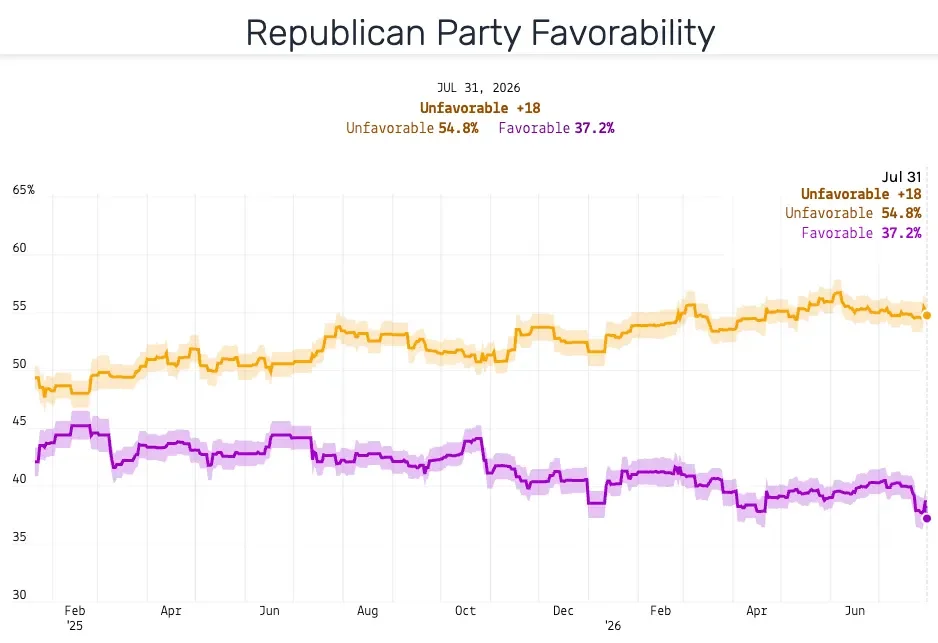
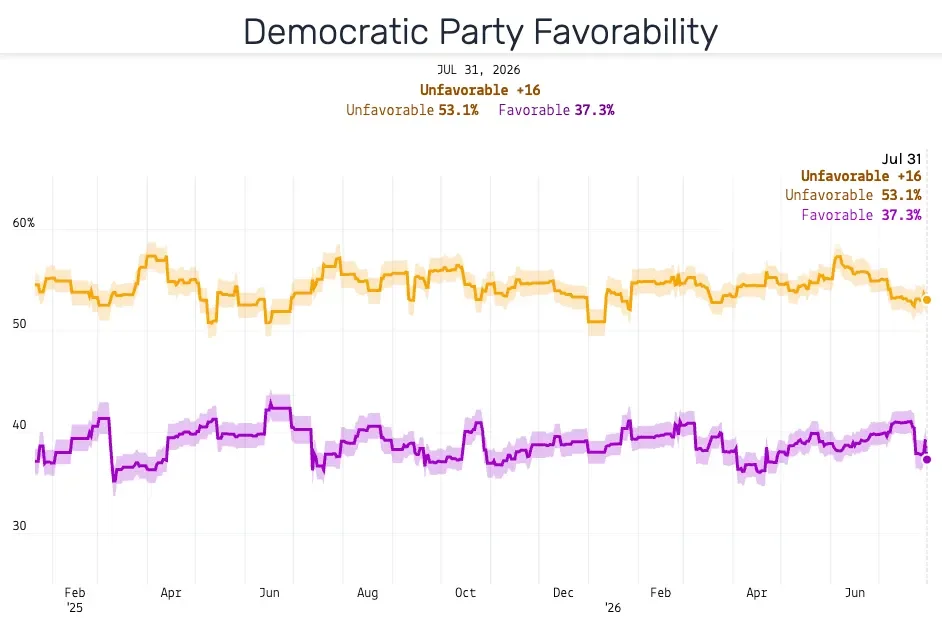
One might also expect that to some degree, there would be an inverse thermostatic relationship between an unpopular president and their political party experiencing declines in favorability, and the out-party experiencing an increase in favorability. Since the 2024 election, that is decidedly not the case. While the Republican Party started from a significantly better position in 2025 on favorability than the Democratic Party, their ratings have declined significantly to… where the Democratic Party has been, consistently, for the last 18 months. Here are the average trends from FiftyPlusOne since the beginning of the Trump administration on favorability of the parties:
There Are Ideological Differences Within the Party, but That Is a Red Herring for Explaining Its Negative Reputation
The discourse over ideological rifts within the Democratic Party is as exhausting as it is annoying, and is toxic not because it isn’t important to have discussions about issues (that is kind of the point of politics), but because it all clearly misunderstands the failures of the Democratic Party on much more fundamental levels. Some key findings from the CNN survey were quite aligned with some insights gleaned from research I conducted at Loft Beck Strategies this spring about what voters want from the Democratic Party. Among Democratic and Democratic-leaning independents in the CNN poll, 83 percent agree that the Democratic Party would be significantly changed for the better by taking a stronger stand against President Trump, and 80 percent agree that it would be significantly bettered by replacing the current leadership. In the Loft Beck Strategies survey, 87 percent of Democrats want the Democratic Party to fight harder against Donald Trump and Republicans compared to just 5 percent who want them to give into them; among those unfavorable toward both parties, 63 percent who want more fight compared to 21 percent who want them to give in. Even among all voters, a 15-point plurality want more fight from the Democratic Party (49 percent to 34 percent who want them to give in to Trump and Republicans).
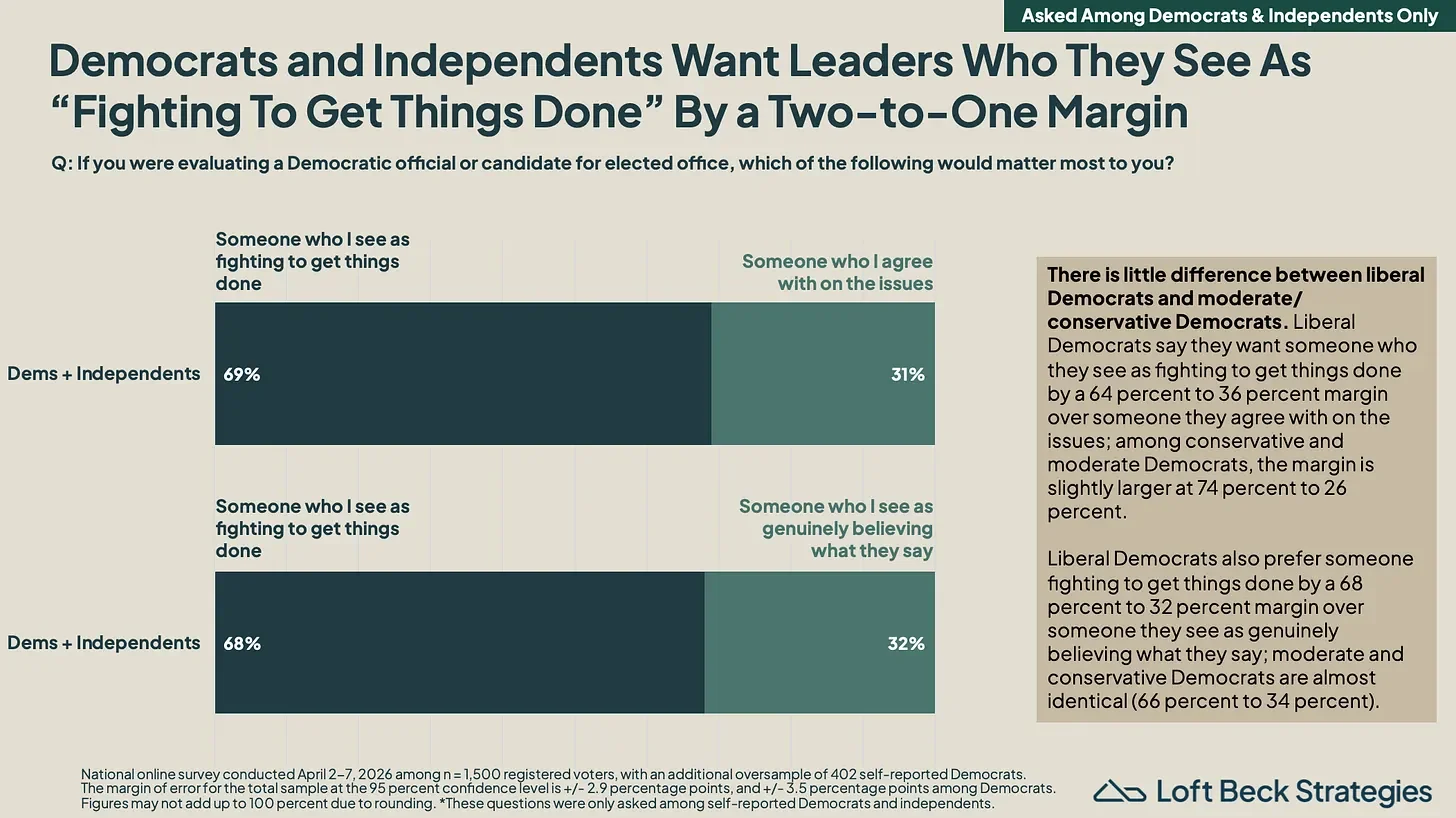
Moreover, fight is what Democratic voters want over ideological purity. In a head-to-head choice, 68 percent of Democrats prefer Democratic officials or candidates who they “see as fighting hard to get things done” over “someone who I agree with on the issues” (32 percent), and there is no difference in these results by self-reported ideology (among liberal Democrats, 68 percent of liberal Democrats want someone with fight over ideological purity, as do 66 percent of moderate/conservative Democrats).
Lastly, going back to Quinnipiac’s trend data for a second, they asked in 2019 about the ideological position of the Democratic Party and found 47 percent of all voters felt it had “moved too far to the left” as compared to 42 percent who said not too far and 4 percent who said it had moved too far right. In their most recent survey this week, how much had this changed? None: 46 percent of voters said too far to the left, with no statistical difference between 2019 and 2026 by partisanship. One would expect that more voters would say they have moved too far to the left since then, yet the decline in the Democratic Party’s reputation is much more acute to the last two years.4
That does not mean there are not real ideological divides within the Democratic Party—my own research has found that and CNN found a nearly even split on what Democrats and Democratic-leaders want—but the broad perceptions that they don’t fight back against Trump and Republicans, don’t get things done, and have ineffective leadership would be more fruitful places to focus on, especially in the aftermath of Graham Platner’s scandals and Ken Martin’s failing leadership at the Democratic National Committee.
1 It’s been 32 years since a Democrat won a statewide election in Texas. At the time of that election, Stargate was the number one movie at the box office, Boyz II Men topped the Billboard charts, and it would be more than a year until Timothée Chalamet was born.
2 A relic of a pre-pandemic world: since the World Health Organization declared COVID to be a global pandemic in March 2020, ratings of the economy have never recovered to net positive territory.
3 While this is just one data source, it’s largely replicable across other publicly available data sources. For example, using YouGov data, Democratic Party favorability has eroded fom net -13 to net -16, Republican Party favorability has improved from net -23 to net -15, the generic ballot was D+5 in both July 2018 and July 2026, Trump’s overall approval declined from net -8 to net -19, and the trajectory of the economy declined a net 51 points from +11 to -40.
4 I highly recommend reading Amanda Litman’s piece on the state of the Democratic Party, it motivated me to finish writing this!
