
How Voters Assess the Democratic Party and What They Want From the Party’s Leaders
In April 2026, Loft Beck Strategies conducted a national online survey to explore how voters currently evaluate the Democratic Party and its leaders, how voters perceive them across a number of ideological dimensions and character traits, and how voters would like to see the Party and its leaders change or behave in the future.[1] This memo explores findings from this survey among the overall electorate, but also focuses on three distinct groups of voters: (1) voters identifying as Democrats, including independents who lean toward the Democratic Party; (2) an audience of “persuadable” voters, defined as being independent or Republican in their partisan identification but who disapprove of President Trump’s job performance; and, (3) “double haters,” defined as those with an unfavorable view of both the Democratic Party and the Republican Party today.[2]
A major overall theme emerging from this survey is that voters—all voters, Democrats, persuadable voters, and double haters—are looking for the Democratic Party to grow a backbone.
Three key findings in this survey reflect that sentiment:
Americans at large—including Democrats, persuadables, and double haters—all want the Democratic Party to fight harder, and hold similar views on its leadership characteristics moving forward. However, those voter groups are divided as to which direction the Democratic Party should move ideologically: Democrats want the party to move left and all other groups want the party to move to the center.
The leaders in the Democratic Party viewed the most favorably are also the ones who voters perceive as being the strongest leaders.
And, when Democrats and independents are evaluating candidates for office, strength is more important to them than either authenticity or ideological alignment.
Current Perceptions of the Democratic Party
Even as President Trump’s overall job handling is deeply net negative (net -13; 43 percent approve – 56 percent disapprove, including 48 percent who “strongly disapprove”), the Democratic Party’s brand is also deeply underwater with the electorate overall and it faces a brand equity problem among its own members. Among all voters surveyed, favorability of the Democratic Party is underwater by 14 points (42 percent favorable – 56 percent unfavorable), and though 80 percent of Democratic voters are favorable toward the Party, only 34 percent are very favorable, with one in five are unfavorable toward their own party (19 percent). Among a series of attributes tested about how well different phrases describe the Party, the attribute Democrats perform worst on in this survey is “standing up to Trump effectively,” which only three in ten voters overall (29 percent)—and just two in five Democrats (42 percent)—say describes Democrats well.
Significant majorities of voters overall characterize the Democratic Party as being ineffective across other attributes, including fighting for people like me (56 percent say this does not describe the Democratic Party well), having strong leadership (64 percent say this does not describe the Democratic Party well), and getting things done (65 percent say this does not describe the Democratic Party well). While three in four Democratic voters believe “fights for people like me” describes Democrats well (74 percent), they are roughly split on other effectiveness measures: just 55 percent of Democrats say “has strong leadership” describes the Democratic Party well, and only 54 percent say that “get[ting] things done” describes them well.
Three Key Findings:
#1: Voters with different political profiles have strongly divergent views about how the Democratic Party and its leaders should position themselves ideologically. However, they are largely unified and sending much clearer signals about what they want and expect from the character and demeanor of their leadership, including fighting against Trump and Republicans. Among all voters, 50 percent think the Democratic Party’s position on policy issues should be more centrist or moderate compared to just 33 percent who want it to move further left.[3] This view is narrowly shared among double haters by 8 points (39 percent more left – 47 percent more centrist/moderate) and overwhelmingly held among persuadable voters by 47 points (12 percent more left – 59 percent more centrist/moderate). At the same time, Democratic voters think the Party should shift left by more than two to one (58 percent more left – 26 percent more centrist/moderate). This variation presents a significant challenge to the Democratic Party moving forward: it will be difficult to satisfy the ideological demands of its existing supporters while at the same time appealing to a broader coalition of voters not currently aligned with Democrats.
However, there are numerous dimensions where voters overall and among these groups agree about the future direction of the Democratic Party. By 15 points among all voters, they think the Democratic Party should fight against Trump and the Republican Party (49 percent) over giving in to them (34 percent). This includes Democrats by an overwhelming 82-point margin (87 percent should fight against them – 5 percent should give in to them) and double haters by 42 points (63 percent should fight against them – 21 percent should give in to them). Persuadable voters are more split, but a 13-point plurality favors fighting (39 percent) over giving in (26 percent).
This is far different from where voters currently see the Democratic Party. When testing attributes about the Party, only 39 percent of all voters think “standing up to Trump” describes it well (compared to 56 percent saying it does not describe the Party well); even fewer say “stands up to Trump effectively” describes the Party well (65 percent say it does not describe the Party well). Among Democrats, only half think the Democratic Party is “standing up to Trump” (52 percent describes well), and only 42 percent say “standing up to Trump effectively” describes the Party well.
There is significant alignment among Democrats, persuadable voters, and double haters on several other dimensions, including strong preferences for favoring the Democratic Party and its leaders having bigger ideas over smaller ones, being authentic over appealing to what they think voters want to hear, and offering a more forward-looking vision over focusing only on opposing Trump and Republicans’ agenda. Some more detailed results include:
Democrats should have bigger ideas over smaller ideas (by a net 50 points overall, net 78 points among Democrats, net 56 points among double haters, and net 36 points among persuadable voters);
Democrats should say what they really believe over adapting to what voters want to hear (by a net 46 points overall, net 49 points among Democrats, net 57 points among double haters, and net 51 points among persuadable voters);
Democrats should focus on proposing their own agenda rather than focusing on opposing Trump and Republicans’ agenda (by a net 37 points overall, net 18 points among Democrats, net 41 points among double haters, and net 48 points among persuadable voters);
Democrats should focus on pushing big reforms after Trump rather than focusing on the way things were before Trump (by a net 34 points overall, net 39 points among Democrats, net 51 points among double haters, and net 33 points among persuadable voters); and,
Democrats should have leaders that are political outsiders rather than being political insiders (by a net 18 points overall, net 10 points among Democrats, net 55 points among double haters, and net 37 points among persuadable voters).
#2: The leaders in the Democratic Party who are viewed most favorably by voters are also seen as the strongest leaders; the least popular Party leaders are also seen as being the weakest. Meanwhile, favorability of leaders does not neatly track their perceived ideology. This survey asked respondents to rate 11 Democratic elected officials on three different dimensions: how favorable they are to each, how strong or weak a leader they think each is, and where they rate each on a 7-point ideology scale from “very liberal” to “very conservative.” There is a strong correlation between favorability and perceived strength: for example, the most favorable leaders among all voters are Senator Mark Kelly (net +8), Senator Bernie Sanders (net +3), Governor Josh Shapiro (net +2), and Congresswoman Alexandria Ocasio-Cortez (net -3). In all cases, they are the top four leaders in perceived strength (Kelly net +7 strong, Sanders net +8 strong, Shapiro net +9 strong, Ocasio-Cortez net +5 strong). Conversely, the most unfavorable officials tested—Joe Biden (net -15) and Senate Majority Leader Chuck Schumer (net -28)—are also seen as weaker leaders (Biden net -34 strong; Schumer net -30 strong).
However, the relationship between favorability of these officials and how they are perceived ideologically is more complex: those with the highest net favorability ratings are a mix of those seen as more moderate (Kelly, Shapiro, Governor Wes Moore, Governor J.B. Pritzker) and two officials who are seen as among the most ideologically liberal (Sanders and Ocasio-Cortez).[4]
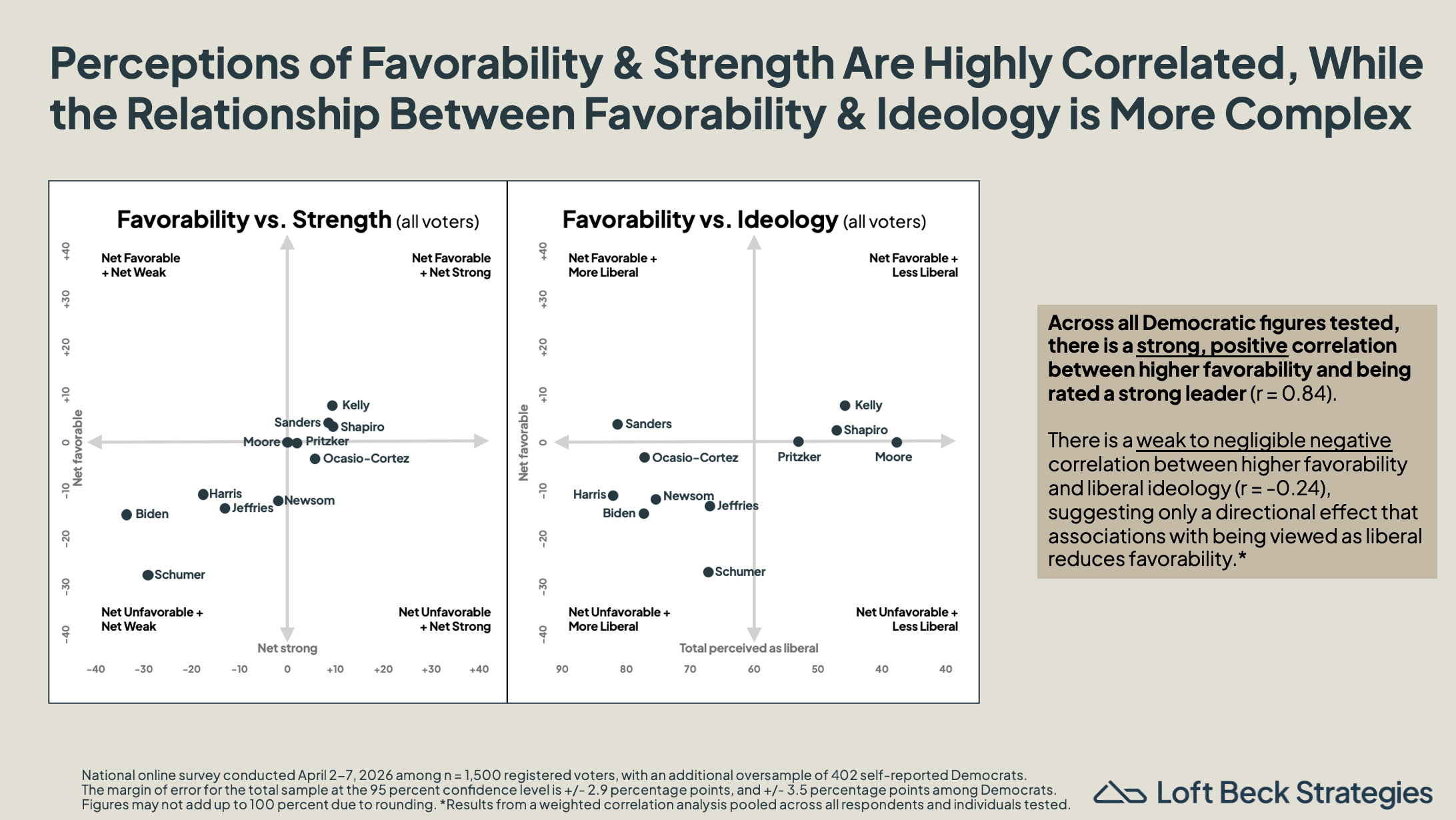
The current and recent institutional leaders of the Democratic Party, including Biden, Kamala Harris, Schumer, and House Minority Leader Hakeem Jeffries, have double-digit net negative favorability ratings and are among the lowest of the 11 figures tested in this survey. That may reflect the finding that only 32 percent of voters surveyed believe “has strong leadership” describes the Democratic Party well—a view held by just 55 percent of Democrats, 13 percent of persuadable voters, and only 9 percent of double haters.
Self-reported Democrats behave similarly to all registered voters when it comes to the relationships between favorability, strength, and ideology. That is especially true after accounting for lower name recognition or less formed opinions. When looking at the favorability and strength of the officials in this survey among only those with formed opinions about them, Democrats rate Sanders, Ocasio-Cortez, Kelly, and Pritzker as the most favorable and strongest officials, notwithstanding the fact that Sanders and Ocasio-Cortez are seen as the most liberal, Kelly is seen as among the most moderate, with Pritzker in between.[5]
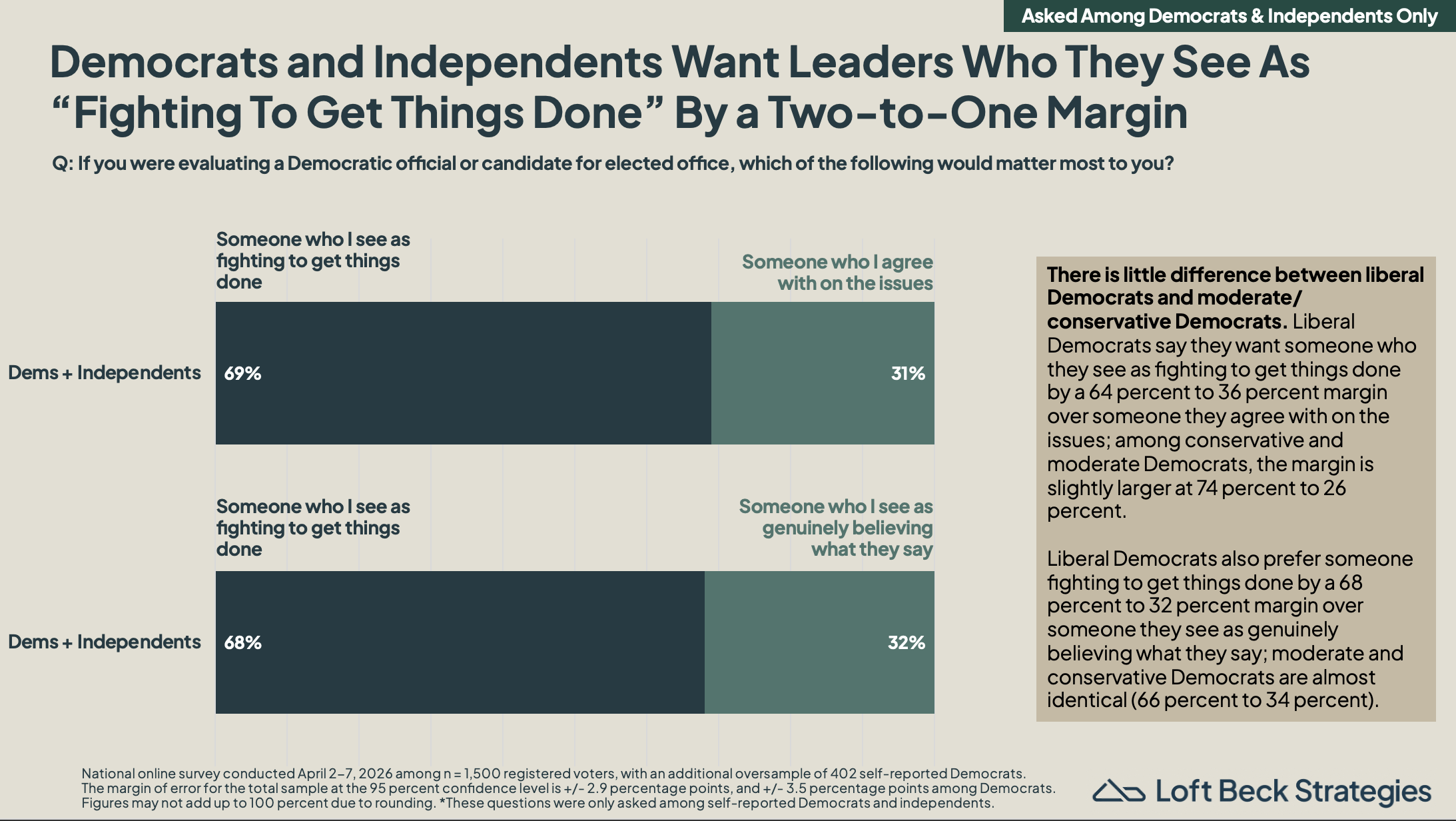
#3: In a direct head-to-head choice, Democratic and independent voters say they prioritize strength as more important than ideological alignment or authenticity when considering who to vote for. This survey asked these voters which mattered most to them in evaluating a Democratic official or candidate for elected office. By a more than a two-to-one margin, 69 percent of Democratic and independent voters said that “someone who I see as fighting to get things done” mattered more to them than “someone who I agree with on most issues” (31 percent). In a separate question, 68 percent agreed that it mattered more that a Democratic candidate or official was “someone who I see as fighting to get things done” than that the official was “someone who I see as genuinely believing what they say” (32 percent).
Double haters also agree with these preferences: 57 percent say “someone who I see as fighting hard to get things done” matters more than someone they agree with on most issues, and 65 percent say the same over someone they see as genuinely believing what they say (35 percent).
Liberal Democrats do not vary substantially from non-liberal Democrats when it comes to prioritizing fight over ideology or authenticity: they want someone who they see as fighting to get things done over someone they agree with on the issues by 28 points (64 percent to 36 percent) and prefer someone fighting to get things done by 36 points over someone they see as genuinely believing what they say (68 percent to 32 percent).
Conclusion
Collectively, these key findings build on what other recent public opinion surveys, like those from NBC News in March 2026, AP-NORC in April 2026, and Strength in Numbers in April 2026, have found: there is deep frustration with the Democratic Party and its leadership, and that there is a broad desire to see the Democratic Party fight harder and demonstrate strength in standing up to President Trump and Republicans in Congress.
Appendix: Target Segments Composition and Political Identity
Democrats: 48 percent of the total sample (including 9 percent who identify as independents that lean toward the Democratic Party)
An oversample of 402 additional self-reported Democrats was included in data collection for this survey.
Party ID:100 percent Democratic
54 percent strong Democrat
26 percent not very strong Democrat
20 percent lean Democrat
Favorability toward the Democratic Party: net +61; 80 percent favorable – 19 percent unfavorable
34 percent very favorable
46 percent somewhat favorable
Persuadable: 11 percent of the total sample
Defined as:
Must either be self-reported independents or Republicans
Must disapprove (somewhat or strongly) of President Trump’s job handling or be unsure how to rate his job handling
Party ID: 0 percent Democratic
Favorability toward the Democratic Party: net -58; 19 percent favorable – 77 percent unfavorable
32 percent somewhat unfavorable
46 percent very unfavorable
Double haters: 16 percent of the total sample
Defined as: Unfavorable to both the Democratic Party and the Republican Party
Party ID: +16 Democratic (including leaners)
50 percent Democrats (including leaners)
15 percent independents
34 percent Republicans (including leaners)
Favorability toward the Democratic Party: 100 percent unfavorable
54 percent somewhat unfavorable
46 percent very unfavorable
Favorability toward the Republican Party: 100 percent unfavorable
34 percent somewhat unfavorable
66 percent very unfavorable
1. Loft Beck Strategies conducted a nationally representative online survey among n = 1,500 registered voters from April 2-7, 2026. In addition, the survey had an oversample of n = 402 self-reported Democrats. Data was collected by YouGov and matched against the TargetSmart voter file. The margin of error of the total sample at the 95 percent confidence level is +/- 2.9 percentage points, and is +/- 3.5 percentage points among self-reported Democrats.
2.There is an appendix at the end of this memo for more information about the composition and political identities of these different groups.
3.In the survey, half of respondents were shown this question with the word “centrist” and half of respondents were shown this question with the word “moderate.” The results from this split-sample experiment were not significantly different, and were merged together for analysis across the full sample.
4. Across all Democratic figures tested, there is a strong positive correlation between higher favorability and being rated a strong leader (r = 0.84), while there is a weak to negligible negative correlation between higher favorability and liberal ideology (r = -0.24), suggesting only a directional effect that associations with being viewed as liberal reduces favorability. These results are from a weighted Pearson correlation analysis pooled across all respondents for all Democratic elected officials tested in the survey.
5. These results exclude anyone who does not have either a favorable or unfavorable opinion of an individual and calculates favorability, strength, and ideology among those familiar with them. For example: Senator Mark Kelly has a 35 percent favorable rating among all voters. When excluding the 38 percent who have heard of him and don’t have an opinion, his adjusted favorability among those familiar with him would be 56 percent.
